

Orthodontics



Last Update Date: 12/2/2025 9:05:38 AM
Orthodontics is a branch of dentistry that primarily focuses on ensuring the proper alignment of teeth and jaws. The word derives from the Ancient Greek words orthos, meaning "straight, correct," and odons, meaning "tooth."
Orthodontics is a branch of dentistry that focuses on the proper alignment of teeth, jaws, and facial structures. The goal is to improve both aesthetic appearance and jaw and tooth function.
Orthodontic treatment is performed in cases where teeth are crooked, spaced, or misaligned. During this treatment, braces, clear aligners (such as Invisalign), brackets, or other appliances are used to bring the teeth into the correct position.
The Goals and Conditions of Orthodontics
Orthodontic treatment aims for both aesthetic and functional improvement. Its primary concerns are:
- Cropped Teeth: Overlapping or irregular alignment of teeth due to insufficient space in the jaw.
- Gapped Teeth: The presence of spaces between teeth.Malocclusion: The misalignment or irregularity of the upper and lower jaw teeth (for example, the lower jaw being forward and the upper jaw being forward).
- Jaw Developmental Disorders: Imbalances and skeletal deformities in the jaw bones.
- Speech and Chewing Functions: Improving these functions by correcting the teeth's alignment.
- Impacted Teeth: The adjustment of teeth trapped within the jawbone into their proper position.
Dental Misalignments (Imbalances Related to Tooth Alignment)
These are problems resulting from the misalignment of teeth, even if the jaw structure is generally normal:
- Crowded Teeth (Crowding): The overlapping, rotation, or irregular alignment of teeth due to insufficient space in the jawbone for the teeth to align properly.
- Diastema: The presence of excessive spaces between teeth. This is usually caused by a tooth size/jaw size discrepancy, missing teeth, or an unusually thick lip ligament (frenilum).
- Impacted Teeth: Teeth that are trapped within the jawbone and unable to erupt into the mouth due to an obstacle to eruption (especially canines).
- Missing Teeth (Hypodontia) or Supernumerary Teeth: Some teeth are congenitally missing or the presence of an unusually large number of teeth.
Malocclusions
These are misaligned bites between the upper and lower teeth. In orthodontics, they are usually classified using the Angle Classification:
| Class | Description | Molar Relationship | Common Appearance / Result |
| Class I | The bite is technically normal (neutroclusion), but there are alignment issues such as crowding, spacing, or crossbite involving the front teeth. | The mesiobuccal cusp of the maxillary first molar (upper) occludes with the mesiobuccal groove of the mandibular first molar (lower). | Normal jaw relationship, but localized tooth problems (crowding, spacing, rotation). |
| Class II | The upper jaw or teeth are positioned too far forward relative to the lower jaw (Overbite / Retrognathism). | The mesiobuccal groove of the mandibular first molar (lower) is positioned distal (behind) the mesiobuccal cusp of the maxillary first molar (upper). | Often referred to as "buck teeth." Can cause difficulty chewing and a receding chin profile. |
| Class III | The lower jaw or teeth are positioned too far forward relative to the upper jaw (Underbite / Prognathism). | The mesiobuccal groove of the mandibular first molar (lower) is positioned mesial (in front) of the mesiobuccal cusp of the maxillary first molar (upper). | Can severely affect facial profile and often requires orthodontic and/or surgical intervention. |
Other Bite Types
- Deep Bite (Overbite): The upper front teeth overlap the lower front teeth more than normal (almost completely).
- Open Bite: The front or back teeth do not touch each other, leaving a gap between them. This can cause speech (lisping) and bite problems.
- Crossbite: One or more upper teeth bite outside the lower teeth, rather than inside them. This can occur in a single tooth (single-tooth crossbite) or in all teeth (skeletal crossbite).
Jaw and Skeletal Disorders
These are jawbone irregularities that are treated with functional appliances, particularly during growth and development, or with surgery in adulthood:
- Jaw Overdevelopment or Overdevelopment: The lower or upper jaw is underdeveloped or overdeveloped relative to the other.
- Jaw Narrowness: The upper jaw is narrow laterally, causing a crossbite or crowding of the teeth.
- Facial Asymmetry: Imbalances in facial features due to irregularities in the jaw structure.
Functional Problems and Habits
Bad habits and functional problems that, if left untreated, can damage the jaw and teeth structure are also within the scope of orthodontics:
- Temporomandibular Joint Disorders (TMJ Disorders): Pain, clicking, and locking in the jaw joint caused by improper bite or teeth clenching/grinding (bruxism).
- Thumb Sucking, Tongue Thrusting, and Prolonged Pacifier Use: Open bites or jaw deformities caused by such habits.
- Speech and Chewing Difficulties: Inability to correctly pronounce sounds like "s" and "z" or to effectively chew food due to irregular teeth.

Treatment Methods
Orthodontists use various treatment methods tailored to the patient's situation to correct these problems:
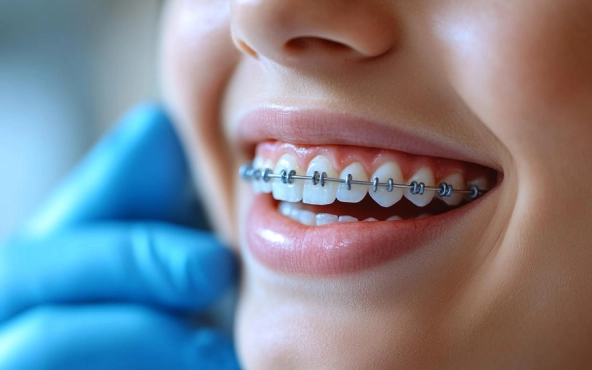
- Braces: This is the most common method. Controlled force is applied to the teeth using metal or ceramic brackets bonded to the teeth and wires passing through these brackets.
- Clear Aligners: Teeth are moved using low-visibility, custom-made, clear aligners that are replaced at regular intervals.
- Removable and Fixed Appliances: Various appliances (palatal braces, chinrests, palatal expanders, etc.) are used to guide jaw development or facilitate simple tooth movement, especially in children.
- Surgical Orthodontics: Combining surgical intervention and orthodontic treatment for severe jaw discrepancies.
Fixed Orthodontic Treatments (Traditional Braces)
These are systems fixed to the teeth by the dentist and cannot be removed by the patient during treatment. They are successfully used for almost all bite and misalignment problems.
Metal Braces:
- This is the oldest, most durable, and generally most cost-effective treatment method. It uses small metal brackets bonded to the tooth surface with a special adhesive and wires connecting them.
- It is very precise in controlling tooth movement.
- It is used in the widest range of applications, including serious and complex malocclusions, severe crowding, and orthodontic cases requiring surgery.
Ceramic/Clear Braces:
- They operate on the same principle as metal brackets, but the brackets are made of tooth-colored or clear ceramic material. This offers a less noticeable alternative for patients with aesthetic concerns.
- They are preferred over metal brackets, especially for adult patients and in cases where aesthetics are a priority.
Clear Aligners
This is the most popular method in recent years and has rapidly become widespread, especially among adults.
- These are clear, removable aligners that are completely custom-made using digital scans of the patient's teeth. The aligners are replaced at regular intervals (usually every 1-2 weeks) to gradually move the teeth. Its greatest advantages are its invisibility and the ability to be removed during eating and brushing. This facilitates maintaining oral hygiene.
- It is effective in treating mild to moderate crowding, gaps, and some malocclusions. Success depends on wearing the aligner for a sufficient number of hours daily (usually 20-22 hours).
Removable and Functional Appliances
- These appliances are self-removable and are most commonly used in children and adolescents.
- Rather than changing the position of the teeth, they aim to guide the growth and development of the jawbone, particularly during growth and development (skeletal disorders).
Examples:
- Jaw Expanders (RPE): Used in children with a narrow upper jaw to expand the jawbone laterally and correct crossbites.
- Functional Appliances (Bionators, Activators, etc.): Used in children with a receding lower jaw to promote growth of the lower jaw and maintain harmony between the upper and lower jaws.
- Simple Aligners: Used to prevent bad habits such as thumb sucking or to facilitate very minor tooth movements.
What is Surgical Orthodontics?
Surgical Orthodontics, technically known as Orthognathic Surgery (Jaw Surgery), is a treatment approach used to correct severe skeletal (jaw) discrepancies where orthodontic treatment alone is inadequate.
In this treatment, teeth are aligned with orthodontic braces.